Ekta Shah: Injured but Unbroken – Nepal's Gen Z Protest Hero
In Nepal's capital, with its ancient temples and modern anarchy, 18-year-old student Ekta Shah left her home in Bhaktapur on September 8, 2025. Dressed in casual clothes and gripped by deep panic, the young, ambitious girl soon found herself a symbol of her generation's struggle against deep-rooted corruption and oppressive power.
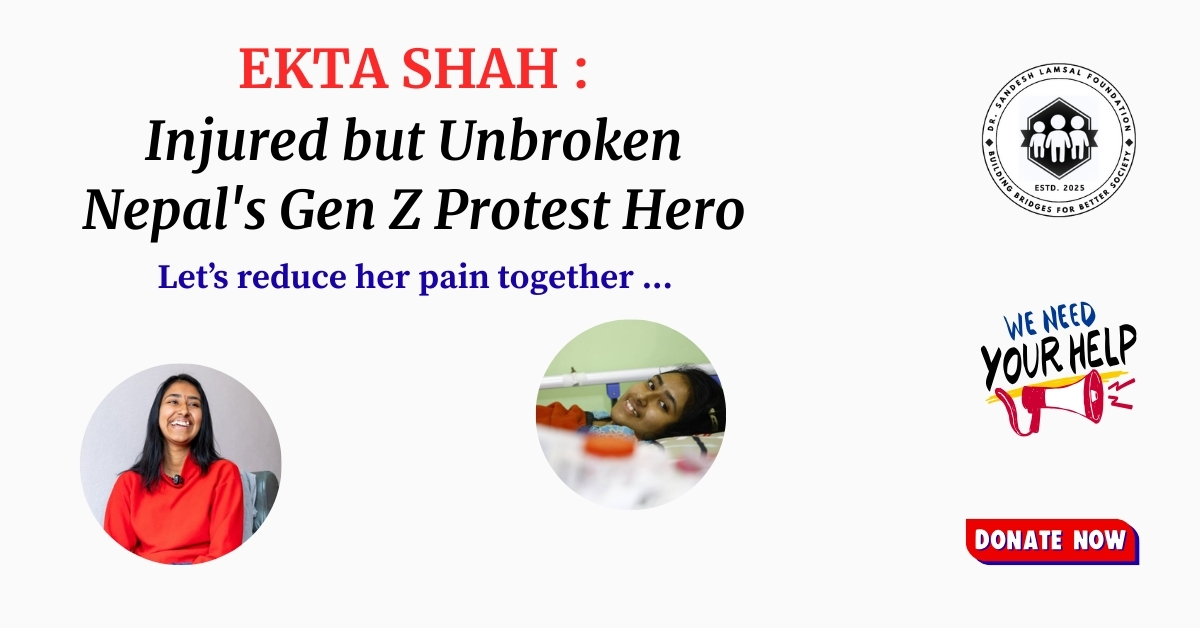
Similar to most of her contemporaries, Shah had been raised in a politically unstable and economically disadvantaged Nepal. Being born in the post-democracy movement that shook the monarchy in 2006, she is a member of Generation Z, which is also social media-fluent and very impatient with the slow rate of change. That morning, she was among thousands of youthful demonstrators in one of the main residential neighborhoods of Kathmandu, the Baneshwor, that were holding the government to task over the scandals that were rocking the government. The spark? An unpopular social media restriction by the government that many perceived as an effort to curb opposition as anti-corruption sentiments had gained momentum.
By the afternoon, the protest had increased. The security forces were involved in riots with the crowd, which required the use of tear gas, rubber bullets and in some instances, live ammunition. In the storm, a bullet hit Shah in the leg and she fell on the ground and the surrounding was very chaotic. She was rushed to a local hospital where she was given a grim prognosis: she would have to undergo several surgeries and then a lengthy period of recovery that would likely ruin her dreams of becoming a doctor. However, her experience was beyond her personal tragedy and it revealed the hefty burden of the youth-led revolution in Nepal.
The demonstrations that rocked Nepal in September 2025 were a paradigm shift in the politics of the nation. It was not an organized movement, as the other ones were, associated with one of the existing parties or ethnic groups, but a very organic one, driven by such social media networks as Tik Tok and WhatsApp. In Nepal, young Nepalis fed up with corruption, unemployment, inequality, and lack of leaders would conduct leaderless rallies, which attracted tens of thousands of followers. Demonstrators in Kathmandu alone burned government buildings, as a symbol of their anger with a system which had not served them. The violence reached its highest point on September 8 and 9 where the police actions claimed the lives of at least 19 people including a 12 year old and hundreds of others.
Human rights organisations criticised the reaction as being disproportionate. Amnesty International has reported cases of illegal killings and the use of excessive force, which demanded accountability. These fears were also printed by Human Rights Watch, which indicated that there was indiscriminate firing by security personnel on crowds. The move by the government to block Facebook organising had a backfire effect because demonstrators responded by using coded applications and offline connections, which enhanced their voices all over the world.
The participation that Shah had was not a planned activism but a logical continuation of her values. The daughter of a humble family, she had been laser-focused on her medical entrance exams, and education was her way out of the financial uncertainty. Her friends talked of her as a strong-willed person, optimistic, and one who could juggle studies with some silent agitation of social problems. On the tragic day, she walked with her peers and gave slogans of transparency and improved opportunities. The bullet that struck her broke surgeons three weeks spent in hospital and her continuing physiotherapy.
Her mother, Bunu Shahi, sat back aghast as her future, as far as her daughter was concerned, was in the balance. Even during interviews with local media, Shahi criticised the authorities because of their brutality and indifference thereafter. There were no authorities who came to visit the family, and medical bills piled on with no government assistance. They moved with guns, she retorted, but disappeared when assisting the injured was in question. The events experienced in the family highlighted a bigger trend: the protestants abandoned themselves to a healthcare system stretched by poverty and lack of sufficient funding.
Nevertheless, in spite of the pain, Shah did not give up because of her ambitions. She spent nights in her hospital bed and studied from textbooks. She later refined her CEE entrance exam after a few months, which is a test of her strength. Her case became viral on social media and subsequently encouraged other people who had undergone other similar traumatic incidents. Shah, in her infrequent public remarks, said little of her injury, and much of how systems had failed: of insufficient education, of employment opportunity, of a democracy that pledged much yet furnished little.
The Gen Z rebellion in Nepal can be discussed as a part of the worldwide youth rebellion. In Kenya, it was the anti-tax movements that caused the youth to use computer technologies to fight a bad regime, and in Morocco, they were demanding a change to their system. This trend resonated with past historical movements such as the 1990 Nepal democratic People's Movement in Nepal, with a new nuance in it. The population of Gen Z (more than 40 per cent) was facing its own problems: the environmental vulnerability to climate in the Himalayas, the economy reliant on remittances, and brain drain as graduates ran away to other countries. Unemployment lingered at 12 per cent as well as among the younger generations, and this created uproar.
The effect of the protests was fast. Prime Minister KP Sharma Oli resigned during the turmoil to allow an interim government and elections in 2026. Social media was later lifted, and anti-corruption promises came about. However, the critics have doubts about the extent of transformation. They now hold protests which are organised under loose coalitions pledging to check the poll and demand constitutional amendments in order to deal with inequality.
This awakening of the generation has redefined the politics of Nepal. The voices of the youth, who were formerly on the fringes, have come to the table. Analysts observe how this could be similar to the Bangladesh ousting of Sheikh Hasina led by students earlier this decade, when the power of the grassroots was enhanced by the use of social media. In Nepal, the movement revealed the cracks in a multi-ethnic society where caste, gender and geographical disparities compound youth frustrations. Other women, such as Shah, who made up a good percentage of protesters, brought out gender specific issues, and those issues included lack of accessibility to education as well as discrimination at the workplace.
For Shah, the scars remain. Still some days when it rains, her leg aches, reminding her of that September afternoon. However, she does not give up but instead joins medical school and goes to bat to help fellow-survivors. She told reporters she had not been protesting on behalf of herself. It was a Nepal where youths can dream without fear.
Nepal is at a junction point as the elections are near. The Gen Z revolution demonstrated that even common people, with the help of smartphones and belief, can overthrow leaders. To continue this momentum, however, one will need action in the streets, but policy adjustments, and inclusive governance. The story of Shah as a protestor, then a medical student, sums up this two-sidedness: the price of being right and the prize it brings.Generation Z has left its mark on the history of a country of strong individuals; the Himalayas is the representation of the persistence of power. They have come out of nowhere, at a high price and will not dissipate. Their narrative symbolized by the character of Ekta Shah is an indicator that the future of Nepal will be occupied by those who are daring enough to seize it.
This is not just a single story of Ekta. It can be seen as a whole generation's struggle for the future of Nepal. Young Nepalis all over the country also struggle against the same things as she does as she moves on with her life and works towards her goal of becoming a doctor. The question remains whether their voices will be answered or not. The 2026 elections are an opportunity to change, yet actual progress will not be instant; only votes will do. It requires the responsible conduct of the authorities and the long-term memory of the citizens who are not ready to forget about these sacrifices. The youthful individuals who had gone to the roads in September 2025 appeared. This time, Nepal leaders should do the same.
Call to Action
We cannot let these young lives be forgotten. This is about more than responding to an emergency; it is about preserving human dignity, restoring hope, and supporting those who have sacrificed for a better tomorrow.
Donate Today – Be the Pillar They Need.
Your donation is more than money; it is a message: We see you. We care. We will act.