Nepal Needs Your Support to Combat the Flood in Rasuwa District
On the morning of 26 August 2026, the calm slopes of the upper reaches of Trishuli burst into a terrifying, strange cry. In minutes, a massive grey slurry of pulverised glacier ice and crushed granite raged down the Lhende Khola stream into the Bhote Koshi, turning one of the most important economic routes into an unutterable graveyard. As darkness fell, the physical loss was obvious. Along with the human loss in Timure and Syabrubesi, entire settlements of traders, customs offices and hydel camps were wiped out. Moving downstream in Nuwakot, Dhading, Gorkha, Tanahun and Chitwan, families were seen walking along muddy riverbanks picking up bodies floating back dozens of kilometres from the border.
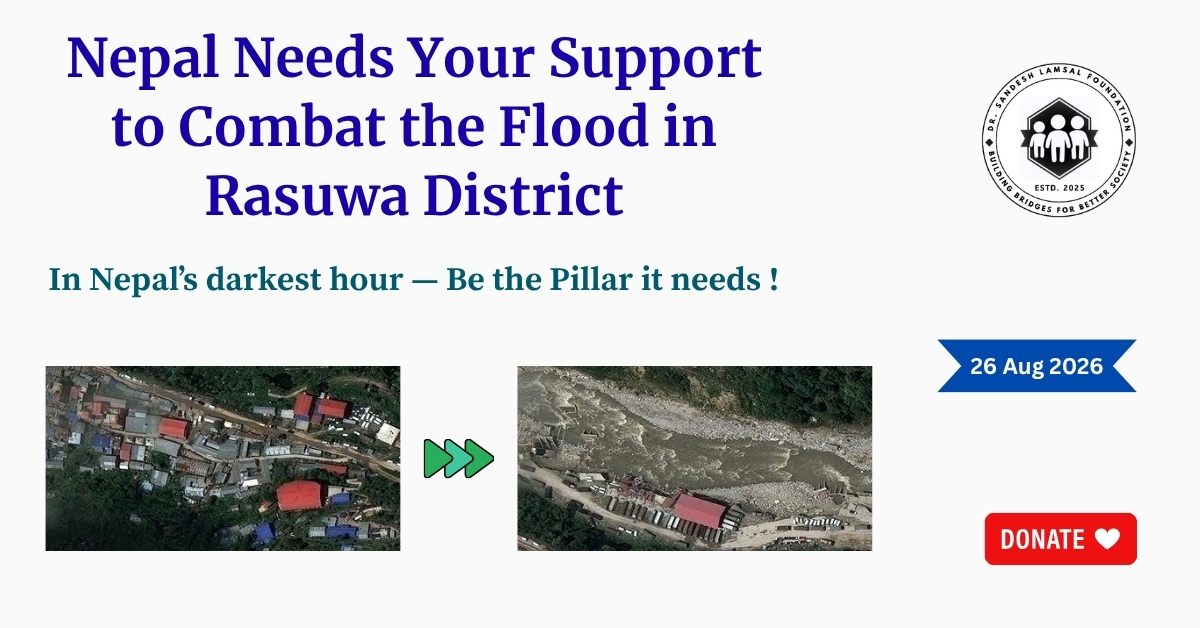
Nepal has suffered the devastation caused by the 7.5-magnitude earthquake that struck Nepal in 2015, many seasonal floods in my country and other natural disasters. However, this shocking turn of events evidences a terrible fact: the mountains here are evolving beyond our organisational ability to keep pace. It has caused tremendous human and financial loss.
Not only local villagers and international trekking groups, but also security forces, medical workers, customs officials, and Mount Kailash pilgrims were stuck with them. In addition to the loss of life, the surge tore up kilometres of essential highways, power stations, and isolated thousands of people without basic support.
Anatomy of the Disaster: Facts, Timeline, and Official Tallies
The disaster unfolded rapidly. Initial automated seismic readings registered a 4.4 magnitude event, leading early commentators to suspect a tectonic earthquake. International agencies, however, refined the satellite mapping, and seismic wave data confirmed that the cause was a high-altitude glacial collapse and ice-rock avalanche coming from around 5200m on the Xizang (Tibet) side of the border.
An estimated mass of glacier ice sheared off a steep face and plunged into the narrow upper catchment. A high-velocity flow of water, mud and river sediment was driven by kinetic friction and shear forces, travelling with high speed, mixing the water with the sand and mud and making the river a large, dark slurry.
| Parameter | Extent & Impact Details | Primary Impacted Zones |
|---|---|---|
| Hydrological Reach | ~240 km from Xizang (Tibet) border down through Gandak basin | Rasuwa, Nuwakot, Dhading, Chitwan, Nawalparasi East |
| Human Impact (NDRRMA) | 1,455 Confirmed Dead, 13,795 Rescued, 5,285 Missing, 6,700 Injured |
Death toll: Chitwan (365), Nawalparasi East (225), Nawalparasi West (225), Nuwakot (200), Rasuwa (170) |
| Infrastructure Losses | 42 km road destroyed, 14 Hydropower projects (~748 MW) damaged | Gyirong Port, Rasuwagadhi, Trishuli-1, Upper Trishuli |
| Economic Vulnerability | 9 bank branches swept away, key overland trade severed | Border trade posts, local commercial banks, tourism hubs |
According to the National Disaster Risk Reduction and Management Authority (NDRRMA) and Home Ministry Situation Reports, more than 21,500 security personnel, including the Nepali Army, Nepal Police, and Armed Police, were deployed alongside air units. Air evacuations have already rescued more than 12,000 individuals from isolated pockets via thousands of operational rescues.
But the missing tally underscores the fragility of trans-border infrastructure, including hundreds of foreign nationals and hydropower staff locked in access tunnels, border security officials and locals themselves, beneath millions of tons of compacted silt and stone.
Early Warnings and Digital Fiasco
The 26 August surge exposed a clear gap in technology: traditional models of river-level monitoring are designed for monsoonal rain, and cannot detect high-altitude ice-rock avalanches. Automated alerts were also less effective as the mobile towers were destroyed upstream.
Private citizens and digital volunteers contributed important information during the initial hours, as no "signs" were provided. Autonomous initiatives, such as the Rasuwa–Bhotekoshi Flood Bulletin established by civic tech volunteers including Niraj Bhusal, were able to swiftly gather verified field data, local contacts, and notices of missing persons with relative ease.
Although civic technology proved to be an important source of timely information for family members, it also underscored a more fundamental structural challenge. Digital tools depend on the mobile network and power grid, both of which failed in the upper valley within a few minutes of impact.
On top of that, the rescue operations were temporarily halted after satellite imagery showed two temporary barrier lakes caused by debris dams. The initial risk from the outburst was manageable. But this incident highlighted problems including 'secondary hazards' when there was no ground-truth check in real time for the outburst at high altitude.
Identity, Mobility, and Verification in a Disrupted Corridor
The Rasuwa–Trishuli is one of the economic and cultural arteries of Nepal connecting to China outside the disaster zone as well. It is well known for its load of heavy freight container traffic, hydro-construction staff, local traders, and international pilgrims coming north.
The surge dismantled the infrastructure of verification. The border clearance posts, municipal registry records, and police checkposts were swept away. The task of recognising missing persons became chaotic and difficult. Families desperately rushed to check if any of their loved ones had been trapped in hydro tunnels, left stranded on isolated ridges or swept downstream to the Narayani River.
Such disasters undermine fundamental rights guaranteed under Nepal’s 2015 Constitution. Specifically, the Right to Life (Article 16), the Right to Information (Article 27), and the state's constitutional obligation to protect citizens during emergencies are heavily impacted. Public registries are not functional during disasters. The relatives have to contend with agonisingly clouded procedures to claim a body, to request emergency relief, to confirm a missing family member across municipal and district boundaries.
Coordination Gaps, Cross-Border Realities, and Governance Duties
The catastrophe exposed ongoing friction points within Nepal’s three-tiered federal structure:
- Federal Leverage vs. Local Realities: The NDRRMA has the policy mandate, well-equipped rescue teams, and high-end helicopters, while authorities at the local and state level without basic earth-moving equipment, satellite connectivity, or adequate emergency funds are the first responders at ground level. This impairs the evacuation of people from congested areas before federal teams arrive in the zone of impact.
- Cross-Border Information-Sharing: Real-time operational data from the upstream catchments in Xizang (Tibet) is proven to be crucial given that the hydrological cascade has its origin in the region upstream of the border. Satellite assessments need to be shared through diplomatic and scientific channels (such as ICIMOD network protocols), while automated joint early-warning protocols between border authorities need to be institutionalised. As mountain rivers operate beyond the limits of geography, on-the-fly data collection of a river pattern needs to be as instantaneous as the flood.
- Infrastructure Planning Liability: Constructing large hydropower dams and the splitting of two-lane trade corridors in high-risk glacially unstable valleys, without resilient structural buffers, is an example of a lack of anticipatory public administration. Climate-resilient engineering should not be an optional luxury; rather, a core public duty.
What Efficient Public Service and Resilience Should Look Like?
- Integrated High-Altitude Early Warning Systems: Sensor networks need to be deployed at high elevations above valley floors, utilising water-level monitors (based on radar), high-frequency satellite synthetic aperture radar (SAR), and acoustic flow sensors that detect mountain collapses minutes before the debris floods main river channels.
- Localised Emergency Capacity: The disaster management system should be decentralised. Emergency reserves and satellite communication stations, along with separate pre-positioned heavy equipment, must be set up in vulnerable areas, such as Syabrubesi and Betrawati, that are not directly connected to Kathmandu’s air-support dispatch.
- Mandatory Climate-Risk Audits for Infrastructure: All future hydropower, highway, and civic infrastructure in the difficult areas must undergo new, mandatory, cascading-hazard audits, and incorporate warming-induced ice avalanche and multi-stage barrier lake formations.
Urgent Call to Action: Save Nepali Lives! Nepal Needs You!
The 26th August 2026 disaster in Rasuwa – Trishuli is a major wake-up call for the entire Himalayan region. Climate change is accelerating, and the price is human lives.
Nepal requires a mammoth global recovery effort. During such difficult times, the frontline Search and Rescue teams, displaced mountain families, and the local government alone cannot take control of the situation. Yes, Nepal is in dire need of global solidarity, sophisticated technical, financial, and logistical support, funding for climate resilience and immediate humanitarian assistance for rescue operations and reconstruction of destroyed infrastructure.
The physical landscape of Rasuwa, Nuwakot, and surrounding places has been permanently altered. However, every action the global community takes during this catastrophe will shape the course in the Himalayas. Protection of all lives in the shadow of the world's tallest peaks requires the same speed of digital monitoring. The global community must join hands with concrete action plans, transparency and adequate investment to protect lives in Nepal.
Dear travellers, if you've already planned your trips to Nepal, please don't cancel them. Nepal is open, and we will welcome you wholeheartedly. Any contributions you make during your stay here in Nepal can play a vital role in the reconstruction process. Nepal urgently needs support from all sources to mitigate the devastating damage caused by the flash flood.
Click here to donate
to the Prime Minister’s Disaster Relief Fund from anywhere in the World.
Your every donation carries the greatest meaning – Be the Pillar that Nepal Needs!
Even a single penny says: We see you. We care. We will act.
Every donation goes straight to the Prime Minister’s Disaster Relief Fund.